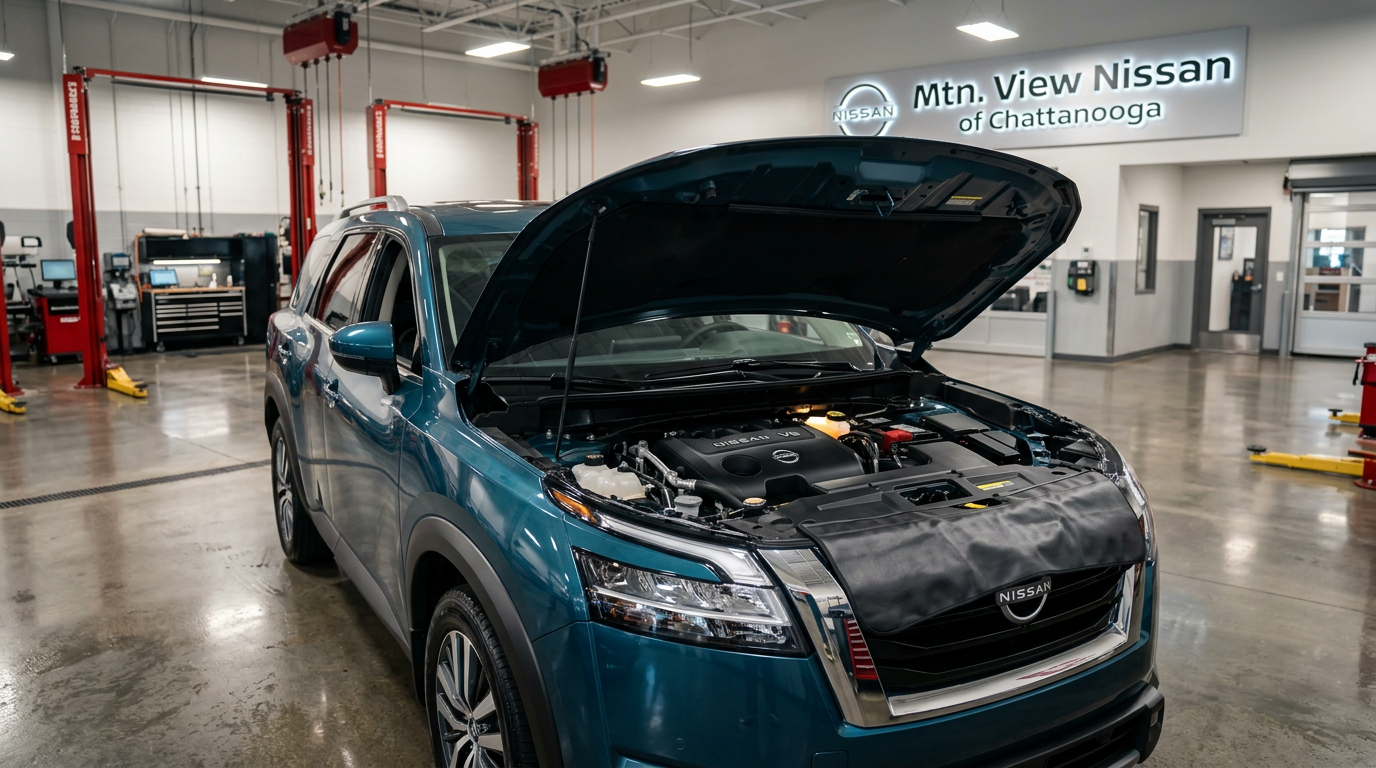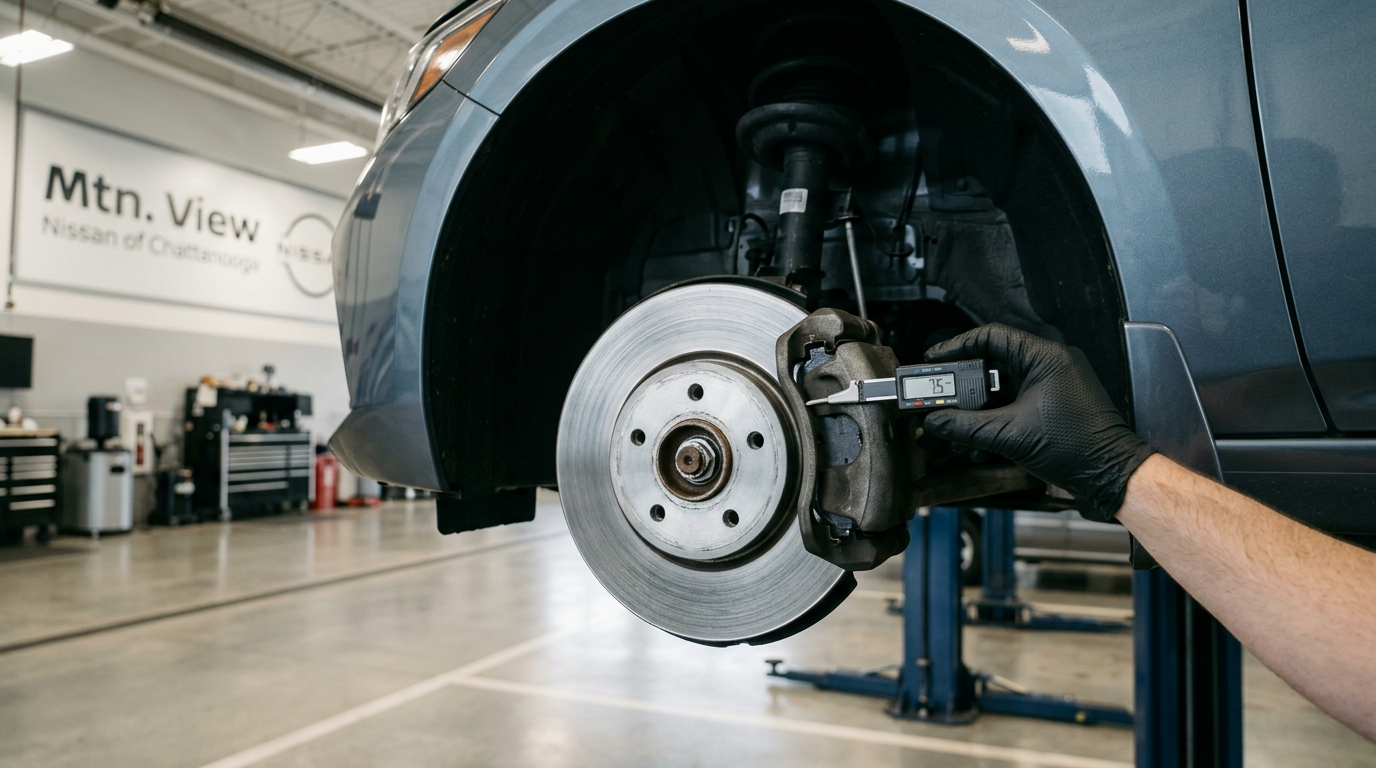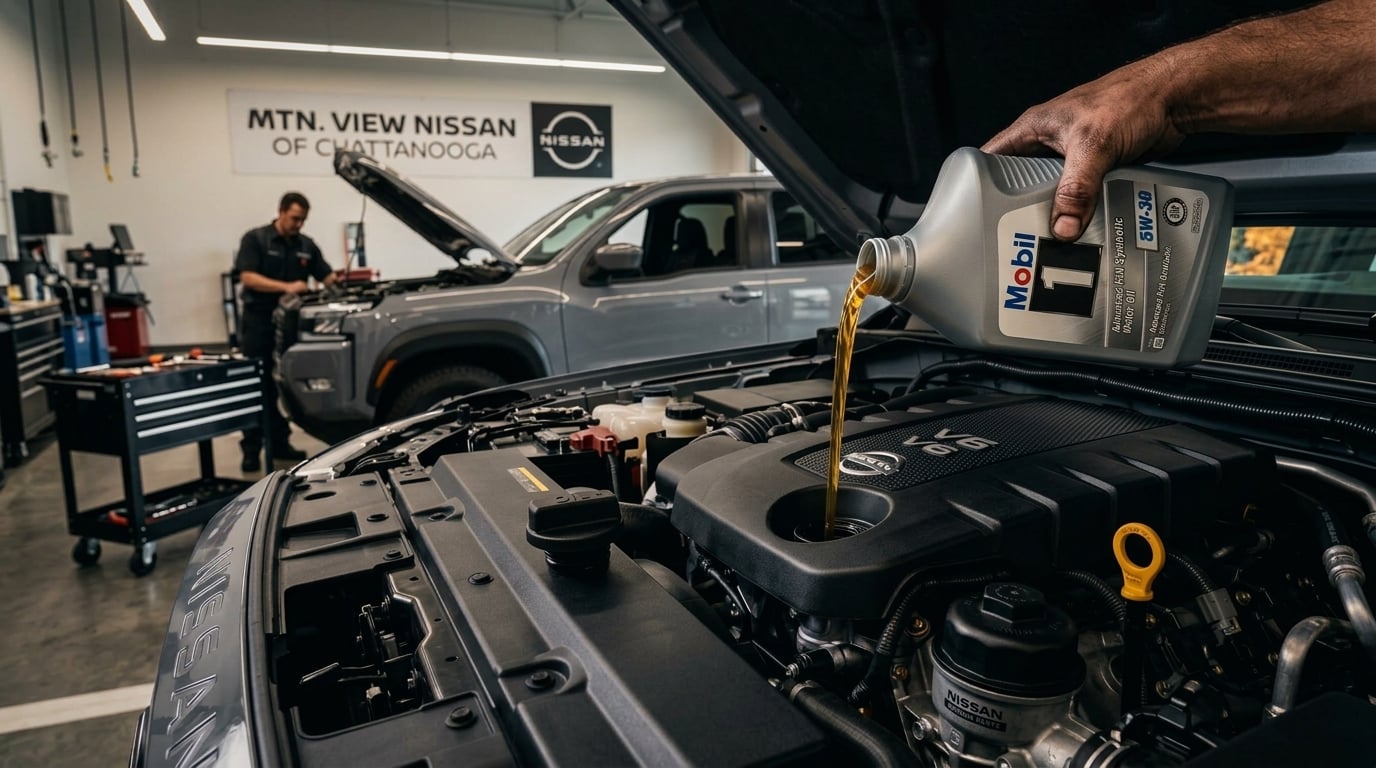
Nissan vehicles require regular fluid checks, selective top-ups, and periodic fluid exchanges across six essential vehicle systems: engine motor oil, transmission fluid, engine coolant, hydraulic brake fluid, windshield washer fluid, and drivetrain gear lubricants. Neglecting these fluids allows thermal breakdown, chemical oxidation, and mechanical friction to wear down critical internal components, resulting in costly mechanical repairs.
Engine oil lubricates the engine block and removes combustion debris. Recommended oil change intervals depend on your specific powertrain. A Nissan Rogue with a variable-compression turbocharged engine permits up to 7,500 miles or one year between oil changes, whereas an Armada equipped with an endurance V8 allows up to 10,000 miles or one year under normal operating conditions. Drivers should consult the exact schedule in their model-specific owner manual rather than assuming a single standard fits every vehicle.
Driving conditions around the Appalachian Ridge-and-Valley terrain in Chattanooga—especially prolonged climbs and descents near Lookout Mountain—place elevated thermal loads on engine cooling and transmission assemblies. Towing heavy recreational equipment, carrying packed passenger loads, or commuting in high summer temperatures accelerates fluid degradation.
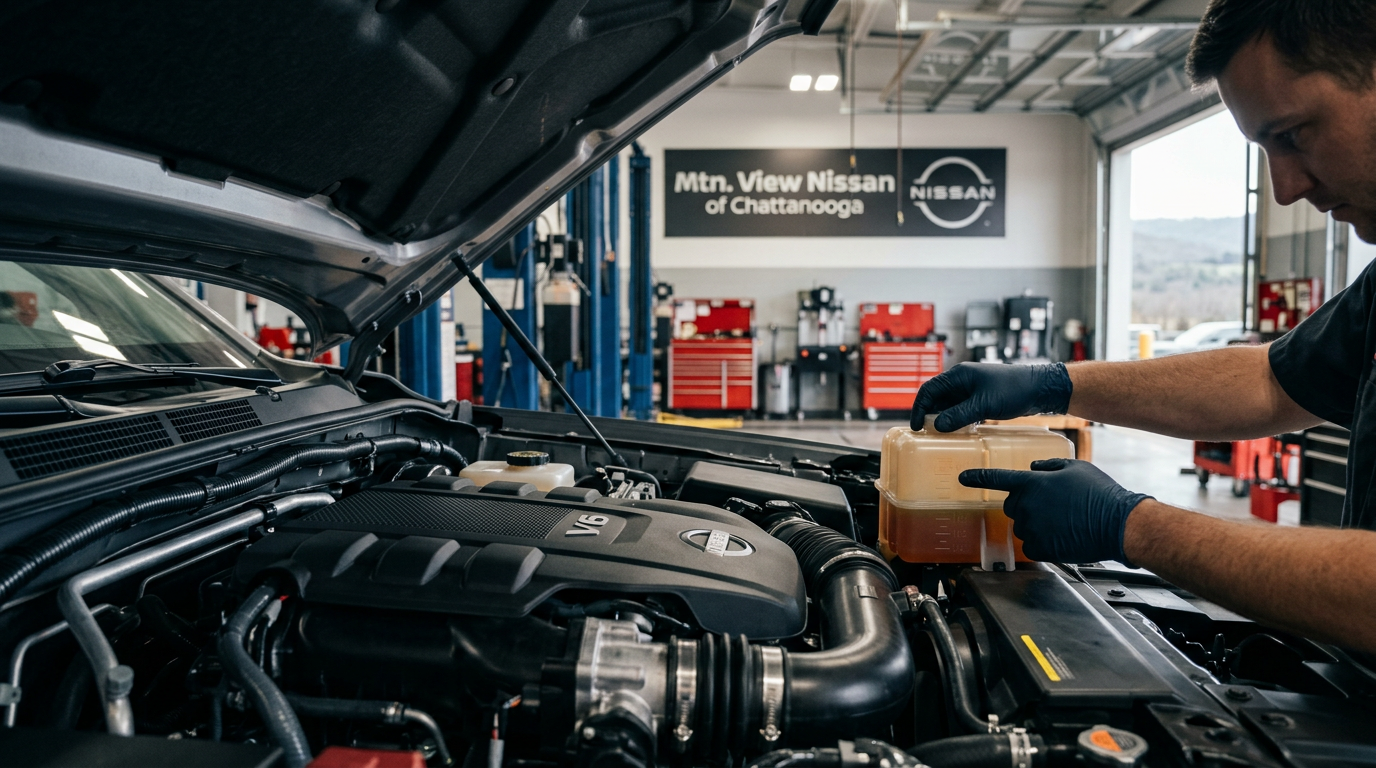
Our technicians inspect fluid levels, reservoir clarity, and seal conditions whenever your vehicle enters the service bay. If you notice fluid spots on your driveway or an unfamiliar temperature gauge reading, stop by our service center on Market Street or give our team a call at (423) 756-1500 to verify your fluid levels.
Table of Contents
- Nissan CVT Fluid Exchange: Capacities and Safe Flushing Practices
- Cooling and Braking Systems: Nissan Capacities and Fluid Specifications
- What Is the Cost Difference Between a Dealership Flush and an Independent Shop?
- What Is Included in an Express Nissan Multi-Point Fluid Inspection?
- Common Questions About Nissan Fluid Care and System Flushes
- Schedule Certified Nissan Fluid Maintenance at Mtn View Nissan of Chattanooga
Nissan CVT Fluid Exchange: Capacities and Safe Flushing Practices
A complete transmission fluid exchange on a Nissan continuously variable transmission (CVT) requires between 8 and 11 quarts of Nissan CVT Fluid NS-3, whereas a standard gravity drain-and-fill procedure drains only 4 to 5 quarts from the pan. High-pressure mechanical flushes are never recommended for Nissan CVT assemblies because forced external pressure dislodges settled particulate matter into delicate valve passages and risks damaging internal hydraulic seals.
Nissan CVT Fluid Capacities & Replacement Methods
| Service Procedure | Approximate Fluid Volume |
|---|---|
| Gravity Pan Drain & Refill | 4 to 5 quarts |
| Cooler-Line Fluid Exchange (Low-Pressure Equipment) | 8 to 11 quarts |
| Multi-Cycle Drain, Fill & Circulation (High-Mileage) | 10 to 12 quarts total |
High-mileage CVTs accumulate normal clutch and belt wear particles that settle in low-flow pockets and transmission pan magnets. Introducing aggressive chemical flushing solvents or high-pressure pulse equipment breaks these deposits loose, circulating them directly into the valve body and variable pulley mechanisms. The safe, factory-approved approach uses passive cooler-line fluid exchange equipment driven entirely by the vehicle's internal pump, or successive drain-and-fill cycles run at idle to dilute old lubricant without hydraulic shock.
Fluid chemistry matters just as much as fluid pressure. Nissan continuously variable transmissions utilize steel drive belts or chains that grip against smooth conical pulleys under hydraulic pressure. This interface requires precise friction modifiers found exclusively in OEM formulations:
- Nissan CVT Fluid NS-3: Mandatory for modern models such as the Altima, Sentra, Rogue, and Murano.
- Nissan Matic P ATF: Engineered specifically for geared multi-speed automatic transmissions, including those in the Frontier and Pathfinder.
- Manual and Differential Fluids: Dedicated gear oils formulated with extreme-pressure sulfur-phosphorus additives designed for manual gearboxes and rear differentials on sports cars like the Z.
Using non-approved multi-vehicle fluids alters pulley slip coefficients, degrades seals, and causes belt slippage. If you prefer handling maintenance in your own garage, you can order genuine factory fluids and filters directly through our Nissan parts department.
Cooling and Braking Systems: Nissan Capacities and Fluid Specifications
Modern Nissan crossovers and SUVs hold between 8.5 and 11.5 quarts of engine coolant throughout the engine block, aluminum radiator core, passenger cabin heater core, and expansion reservoir. These cooling circuits require Genuine Nissan Long Life Antifreeze/Coolant (blue), an ethylene glycol formulation utilizing advanced phosphated organic acid technology that shields aluminum engine castings from galvanic corrosion and cavitation erosion.
Cooling capacities vary by powertrain configuration:
- Nissan Rogue: Holds approximately 9 quarts across the entire cooling circuit.
- Nissan Pathfinder: Requires between 10.5 and 11.5 quarts, depending on auxiliary rear climate control lines and heavy-duty radiator options.
- Nissan Z: Features an engine cooling circuit alongside a separate, maintenance-free intercooler coolant circuit designed specifically for its twin-turbocharger system.
Nissan blue coolant delivers an extended service life, but mixing it with green conventional coolant or unapproved universal formulations causes silicate drop-out. This chemical reaction creates a gritty gel that plugs narrow heater core tubes and coats thermostat sensors.
In the hydraulic braking system, fluid specification is equally strict: DOT 5 silicone fluid must never be introduced into a Nissan vehicle. Silicone fluid does not mix with glycol-based fluids, and it degrades the ethylene propylene diene monomer rubber seals used in Nissan master cylinders and brake calipers.
Silicone fluid aerates when cycled through anti-lock braking system (ABS) valves and vehicle dynamic control actuators, creating compressible micro-bubbles that produce a spongy pedal, extended stopping distances, or total hydraulic brake failure. Nissan specifies Genuine Nissan Super Heavy Duty Brake Fluid or an equivalent DOT 3 or DOT 4 glycol-based fluid to preserve pedal firmness and high boiling points under heavy braking.
What Is the Cost Difference Between a Dealership Flush and an Independent Shop?
A complete dealership transmission or cooling system flush generally costs between $275 and $360, while independent repair facilities across the local market typically charge between $200 and $280 for a generic fluid replacement. That price variance stems from specific differences in fluid chemistry, computerized equipment, and technician training.
Independent service centers frequently use universal transmission fluids paired with aftermarket chemical additive packages to service multiple vehicle brands from a single bulk drum. While this reduces labor and material overhead, universal fluids fail to match the precise shear stability and traction characteristics mandated by Nissan CVTs. Dealership service centers use genuine OEM fluids engineered and tested by Nissan engineers.
A factory-certified flush also includes electronic diagnostics. When fresh CVT fluid is added, our technicians connect factory diagnostic scan tools to read internal fluid temperatures, ensuring levels are set within the correct calibration window. The scan tool also clears and recalculates the internal transmission fluid deterioration date counter inside the transmission control module (TCM), a step outside general repair shop workflows.
Basic fluid top-ups represent minimal cost. Checking and topping off windshield washer fluid, power steering fluid, or coolant overflow reservoirs is routinely completed at no charge during scheduled maintenance or for under $15 when requested separately. You can easily reserve an appointment using our online tool to schedule a service appointment online.
What Is Included in an Express Nissan Multi-Point Fluid Inspection?
A Nissan multi-point fluid inspection examines level, fluid clarity, and chemical condition across all vital vehicle reservoirs, providing a complete assessment of your powertrain and safety systems. Quick-service express lanes perform these evaluations during routine visits without requiring an appointment, making it straightforward to maintain vehicles facing daily stop-and-go driving through the Southside in Chattanooga.
During a standard fluid check, our technicians inspect:
- Engine Motor Oil: Inspected for volume, viscosity breakdown, and carbon accumulation.
- Transmission or CVT Fluid: Evaluated using dipstick access or overflow inspection plugs to identify oxidation, darkening, or friction material contamination.
- Engine Coolant: Tested with an optical refractometer to measure freeze protection and boiling point thresholds while verifying overflow reservoir levels.
- Hydraulic Brake Fluid: Tested for copper corrosion and atmospheric moisture absorption, which degrades boiling performance.
- Power Steering Fluid: Monitored on hydraulic-assist models for foaming, pump wear particles, and fluid levels.
- Windshield Washer Fluid: Replenished with seasonal detergent to ensure clear visibility.
A simple fluid top-up corrects minor volume changes caused by evaporation or thermal contraction. A system flush completely evacuates worn, chemically exhausted fluid along with suspended contaminants, restoring clean fluid protection throughout internal hydraulic circuits.
Common Questions About Nissan Fluid Care and System Flushes
Q: How frequently should Nissan CVT fluid be inspected or replaced?
Nissan recommends inspecting the transmission fluid level and condition every 15,000 miles or 12 months. Replacement intervals depend on driving conditions, towing demands, and electronic deterioration data recorded by the transmission control module. Many vehicles operating under severe driving conditions benefit from a complete fluid exchange every 30,000 to 60,000 miles to preserve pulley surfaces and belt life.
Q: Will using non-Nissan fluids void my vehicle powertrain warranty?
Using an aftermarket fluid will not void your warranty by default under federal law, provided the fluid matches Nissan performance specifications. If an unapproved fluid causes mechanical wear, valve sticking, or component failure, repairs related to that damage will not be covered by the manufacturer warranty. Using OEM fluids eliminates this risk.
Q: Why does hydraulic brake fluid darken over time?
Brake fluid is hygroscopic, meaning it naturally absorbs moisture from the air through microscopic pores in flexible brake hoses and reservoir vents. As moisture enters, it corrodes internal copper alloys and steel lines, turning the fluid from light amber to dark brown. Fluid with high moisture content has a lower boiling point, increasing the risk of vapor lock during sudden stops.
Q: Is it normal for engine coolant levels to drop slightly between oil changes?
Small drops in the expansion tank can occur over months due to normal thermal expansion and atmospheric venting. Noticeable fluid drops, sweet odors inside the passenger cabin, or white exhaust smoke indicate an active leak in the radiator core, hose clamps, water pump gasket, or heater core that requires immediate inspection.
Q: What immediate action should I take if a fluid temperature warning illuminates?
Safely pull off the roadway, shift into park, and let the engine idle to allow the cooling fans to draw heat away from the radiator, unless steam is visible. Never open a hot radiator cap, as pressurized boiling coolant can cause severe burns. If mechanical trouble leaves you stranded, contact Nissan Roadside Assistance: 1-800-225-2476 for emergency towing to the nearest authorized service center.
Schedule Certified Nissan Fluid Maintenance at Mtn View Nissan of Chattanooga
Maintaining clean, factory-approved fluids protects your vehicle against excessive wear, preserves mechanical efficiency, and ensures long-term driving safety. When your vehicle requires an express fluid top-up, a comprehensive multi-point inspection, or a transmission fluid exchange, our factory-trained service technicians deliver precision care using genuine OEM fluids and approved diagnostic equipment. Take the next step in protecting your investment by scheduling your service visit online, contacting our service advisors directly at (423) 756-1500, or dropping in to our service center at 2100 Market St, Chattanooga, TN 37408 today.
© 2026 Mtn View Nissan of Chattanooga. All rights reserved.