
Mtn View Nissan of Chattanooga

Blog / Service

What Does the Standard Nissan Factory Warranty Cover?

What Does the Standard Nissan Factory Warranty Cover

The standard Nissan factory warranty includes a 3-year/36,000-mile basic limited warranty and a 5-year/60,000-mile limited powertrain warranty, whichever comes first. Basic coverage protects against defects in factory-installed materials or workmanship, while powertrain coverage safeguards the engine, transmission, transaxle, transfer case, and drive axle assemblies. Nissan also provides a 5-year/unlimited-mileage corrosion perforation warranty covering body sheet metal rust-through.

Understanding the scope of your factory coverage helps keep your vehicle operating smoothly through everyday driving across the Appalachian ridges and steep climbs around Lookout Mountain. The 3-year/36,000-mile basic limited warranty acts as bumper-to-bumper protection. It covers virtually every original factory component—from electronic display screens and HVAC blower motors to power window actuators and safety sensor modules—against manufacturing defects. If a factory-installed component fails prematurely due to material or assembly flaws, repairs are completed using new or remanufactured OEM parts at zero cost to the owner.

The 5-year/60,000-mile limited powertrain warranty focuses strictly on the major mechanical systems that generate and transfer power to the wheels. Inside gas-powered engines, this encompasses internal lubricated components such as pistons, crankshafts, camshafts, timing chains, oil pumps, cylinder heads, and the water pump. For vehicles equipped with Continuously Variable Transmissions (Xtronic CVT®) or traditional automatic gearboxes, coverage protects torque converters, internal clutches, control valves, and transmission control units.

Factory warranty coverage excludes routine maintenance items that experience standard operational friction and wear. Engine oil filters, air filters, windshield wiper blades, key fob batteries, and brake pads are regular maintenance items and are not covered under standard warranty repair unless their premature failure stems directly from a covered mechanical defect. Wheel alignment and tire balancing are similarly limited after initial mileage thresholds.

Federal and state emissions warranties provide additional coverage layers. Federal regulations require emission control components—such as catalytic converters, engine control modules, and onboard diagnostic devices—to carry dedicated extended terms beyond the basic warranty. To confirm coverage details or verify whether a specific symptom qualifies for factory-backed repair, drivers can visit our service center location at 2100 Market St or get immediate guidance by calling our team at (423) 756-1500.

Table of Contents

Does the Standard Nissan Warranty Include Roadside Assistance?

Standard Nissan factory warranty protection includes complimentary 24-hour roadside assistance coverage for 3 years or 36,000 miles, whichever limit is reached first. Emergency services are available 365 days a year across North America, providing immediate dispatch for mechanical breakdowns, towing, flat tire changes, battery jump-starts, fuel delivery, and lockout assistance.

When unexpected road trouble occurs, Nissan Roadside Assistance serves as your exclusive manufacturer-backed emergency support system. Drivers in need of immediate assistance can reach official operators directly by calling Nissan Roadside Assistance at 1-800-225-2476. Having your Vehicle Identification Number (VIN) and current location ready when calling ensures faster dispatching to your vehicle. Owners of equipped vehicles can also initiate emergency support directly from the cabin display using NissanConnect® voice commands.

Unlike generic third-party motor clubs, factory roadside coverage prioritizes long-term vehicle health by towing your vehicle straight to an authorized Nissan dealership. This guarantees that repairs are evaluated by factory-trained technicians using specialized diagnostic tools and genuine OEM parts. Key benefits of official roadside assistance include:

  • Emergency Towing Service: Transports your vehicle directly to the nearest authorized Nissan dealer following a mechanical failure or road incident.
  • Flat Tire Changes: Dispatches a service vehicle to install your operational spare tire on-site.
  • Battery Jump-Starts: Provides immediate battery-boosted starts to get your vehicle running again.
  • Emergency Lockout Service: Offers prompt assistance if key fobs are locked inside the cabin.
  • Fuel Delivery: Delivers emergency fuel supplies directly to stranded drivers.
  • Trip Interruption Benefits: Covers emergency lodging, meals, and substitute transportation if a warranty-covered breakdown occurs more than 100 miles from home.

Because roadside assistance relies on authorized dealer support, repairs performed through factory dispatch preserve your underlying warranty protection. Our service team coordinates directly with tow operators to receive arriving vehicles and begin diagnostic work without delay.

Does EV Thermal Management Failure Qualify for Nissan Warranty Repair?

Thermal management system failures qualify for complete warranty repair under Nissan electric vehicle factory guidelines. Key thermal components—including electric coolant pumps, heat exchangers, battery cooling loops, thermal control valves, and system pressure sensors—are fully covered against manufacturing defects and operational failures.

Electric vehicle battery packs depend on precise liquid thermal regulation to maintain optimal operating temperatures during rapid charging and heavy acceleration. If an electric cooling pump fails or a thermal control valve sticks, the vehicle's onboard management computer triggers diagnostic trouble codes (DTCs) and may limit power output to protect the high-voltage battery modules. Because thermal control systems are essential to high-voltage component health, repairs are covered under dedicated electric vehicle system warranty terms.

When EV drivers visit our facility with cooling indicators or range warnings, our technicians run specialized Nissan diagnostic protocols on thermal loops before performing any warranty service. Diagnostic tests evaluate coolant flow rates, pressure integrity across heating circuits, and thermal sensor calibration data. If a thermal component requires replacement, technicians refill the cooling system with factory-specified non-conductive dielectric fluid and purge air pockets using computerized diagnostic tools.

Coverage for EV thermal systems spans both basic limited warranty periods and dedicated EV component terms. In addition to thermal system coverage, electric drive motors, power inverter modules, and onboard charger assemblies carry explicit factory warranty backing. To keep electric heating and cooling systems operating properly, drivers can easily maintain their maintenance schedule by scheduling a service appointment online.

How Do Nissan Factory Warranty Terms Compare to Toyota?

Toyota offers a similar warranty structure to Nissan, with a 3-year/36,000-mile basic warranty and a 5-year/60,000-mile powertrain warranty. Both manufacturers also provide a 5-year/unlimited-mileage corrosion perforation warranty.

While baseline coverage terms are numerically identical, the comprehensive ownership value differs in component depth and extended protection offerings. Toyota includes two years or 25,000 miles of basic scheduled maintenance, whereas Nissan focuses coverage strength on comprehensive component protection plans and specialized electric vehicle systems.

Coverage Category Nissan Standard Factory Warranty Toyota Standard Factory Warranty
Basic Limited Warranty 3 Years / 36,000 Miles 3 Years / 36,000 Miles
Powertrain Warranty 5 Years / 60,000 Miles 5 Years / 60,000 Miles
Corrosion Perforation 5 Years / Unlimited Miles 5 Years / Unlimited Miles
Roadside Assistance 3 Years / 36,000 Miles 2 Years / Unlimited Miles
Extended Protection Plans Security+Plus (Up to 2,000+ parts) Toyota Extra Care

Nissan backing extends beyond initial factory coverage through optional Security+Plus vehicle service contracts. Security+Plus plans extend coverage options up to 8 years or 120,000 miles, adding protection for over 2,000 individual mechanical and electronic components. These extended programs include rental car reimbursement, extended trip interruption coverage, and full tire road hazard protection.

For electric vehicles, Nissan warranty terms deliver long-term support for high-voltage battery capacity retention alongside core drive electronics. This specialized coverage protects against unexpected capacity loss beyond normal degradation parameters, providing high-voltage confidence for EV owners.

Where Can Drivers Get Authorized Nissan Warranty Repairs in Chattanooga?

Authorized Nissan warranty repairs in Chattanooga must be completed at a certified dealership service center to ensure factory coverage remains valid. Independent repair shops and generic service facilities cannot submit claims to Nissan North America or perform zero-cost factory warranty replacements.

AUTHORIZED WARRANTY SERVICE ADVANTAGE

Certified Nissan Dealership Independent Repair Shops
• Zero out-of-pocket warranty • Full customer out-of-pocket
reimbursement expense
• Factory-trained technicians • Generic multi-brand mechanics
• Genuine OEM replacement parts • Aftermarket or generic parts
• Direct factory software tools • Limited diagnostic access

Our service center provides the technical equipment, specialized software, and master-certified technicians required for complex warranty diagnostics. Whether you commute daily along the Tennessee River waterfront or drive through surrounding valley routes, our facility processes all administrative paperwork directly through the manufacturer. This eliminates out-of-pocket costs for covered mechanical breakdowns.

Using an authorized dealership ensures that every replacement component installed on your vehicle is a genuine OEM part. Genuine parts match the exact engineering specifications, metal alloys, and software calibrations of your vehicle's original factory equipment. Installing unapproved aftermarket components can lead to system incompatibilities that risk voiding portions of your remaining factory coverage.

When minor maintenance items or out-of-warranty accessories are needed, drivers can order genuine factory components through our online parts department. Our certified service team verifies VIN compatibility for every component, ensuring your vehicle maintains its original performance and factory protection standards.

Common Questions About Nissan Warranty Service

Q: Do I need to schedule an appointment for Nissan warranty repairs?

Advance scheduling is required for dedicated warranty repairs and complex diagnostic evaluations. While quick routine items like oil changes utilize Express Service lines, diagnostic work requires reserved bay time and specialized master technician scheduling. Booking your appointment in advance gives technicians the time needed to hook up diagnostic equipment, verify warranty coverage eligibility with the manufacturer, and secure required OEM replacement parts before you arrive.

Q: Is the original Nissan factory limited warranty transferable to a second owner?

The remaining balance of Nissan’s 3-year/36,000-mile basic warranty and 5-year/60,000-mile powertrain warranty automatically transfers to subsequent private buyers at no cost. Factory warranty protection attaches directly to the Vehicle Identification Number (VIN) rather than the original purchaser. Subsequent owners do not need to pay transfer fees or submit formal paperwork to maintain coverage for the remainder of the active time and mileage limits.

Q: What documentation should I bring when bringing my vehicle in for warranty service?

You should bring your vehicle registration, current mileage info, and any historical maintenance records if the repair involves a regularly serviced assembly like the engine or transmission. Presenting clear service documentation proves that recommended maintenance intervals were followed, satisfying factory guidelines and preventing claim approval delays.

Q: Are loaner vehicles or shuttle services available during extended warranty repairs?

Dealerships offer local shuttle transportation and complimentary service loaner vehicles for eligible multi-hour or overnight warranty repairs, subject to availability. Confirming loaner availability when scheduling your repair ensures uninterrupted transportation while your vehicle is in the shop.

Q: Can aftermarket accessories or modifications void my Nissan factory warranty?

Aftermarket parts or custom modifications do not automatically void your entire factory warranty, but damage caused directly by unapproved equipment is excluded from coverage. Under federal Magnuson-Moss Warranty Act standards, the manufacturer must prove an aftermarket component directly caused a mechanical failure to decline a specific claim. Standard factory components unaffected by modifications remain fully covered.

Schedule Your Authorized Nissan Warranty Service Today

Protecting your vehicle with authorized factory warranty service ensures long-term reliability and preserves your manufacturer coverage. Our factory-trained technicians handle every aspect of warranty care—from initial computer diagnostics to direct claim submission with Nissan North America.

When you notice warning lights, unusual mechanical noises, or cooling system indicators, addressing them promptly prevents minor issues from developing into major component failures. Our state-of-the-art service facility at 2100 Market St serves drivers across Chattanooga with specialized repair bays, computerized diagnostic software, and dedicated OEM parts inventory.

Setting up your service visit takes only a moment. You can get directions to our Chattanooga service center for your appointment or reserve your spot today by giving our team a call at (423) 756-1500.


© 2026 Mtn View Nissan of Chattanooga. All rights reserved.

Posted in:

Related Posts

How Often Does a Nissan Sentra Need Brake Service

How Often Does a Nissan Sentra Need Brake Service?

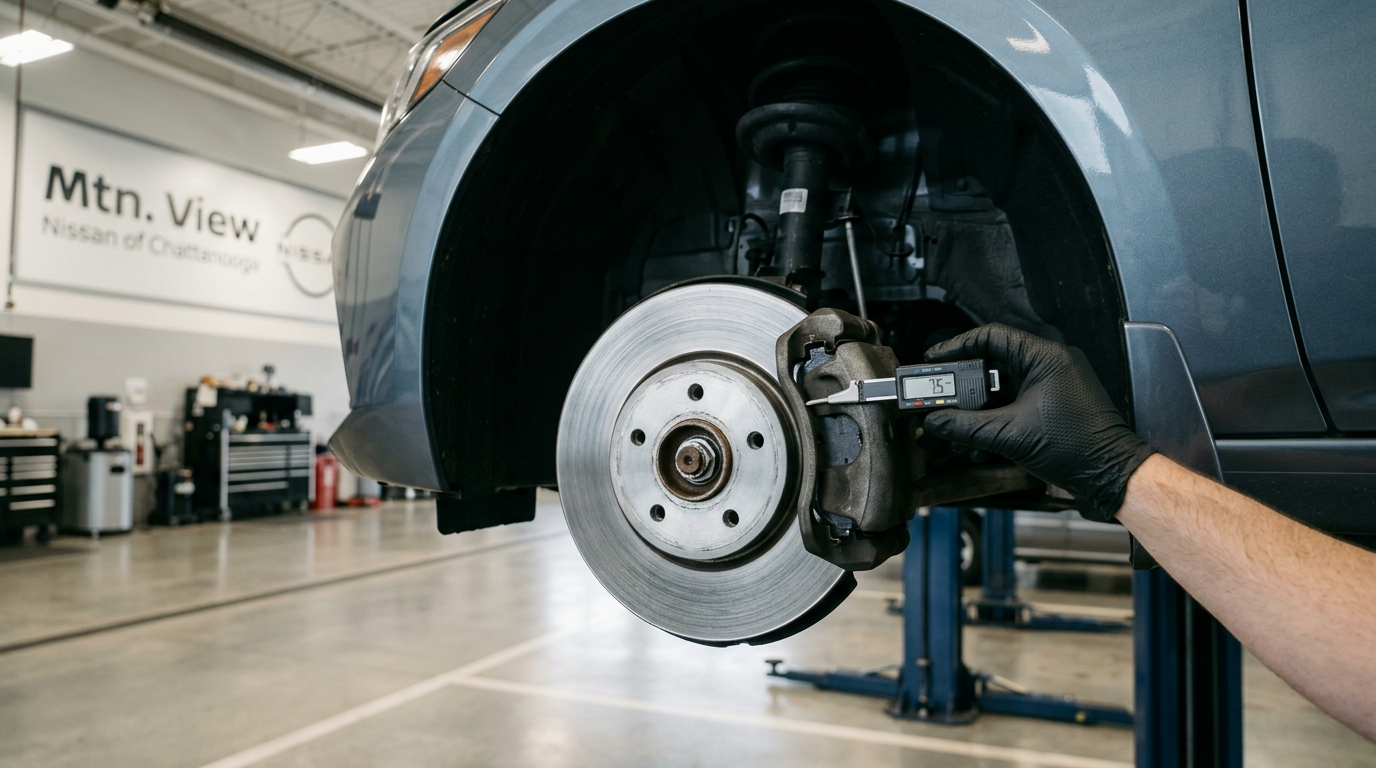
A Nissan Sentra requires a professional brake inspection every 5,000 to 7,500 miles—typically aligned with routine oil changes—while brake pad replacement is generally necessary every 30,000 to 70,000 miles. Exact replacement intervals vary based on individual driving habits, traffic density, and friction material type. Daily stop-and-go commuting along the Tennessee River valley around Chattanooga accelerates pad and rotor wear compared to open highway driving. Keeping up with scheduled brake inspections prevents minor friction wear from developing into costly rotor damage or compromised hydraulic performance. During a standard service visit, factory-trained technicians measure remaining friction pad thickness in millimeters, examine the physical condition of front and rear rotors, inspect hydraulic lines for moisture contamination, and check brake fluid levels. Driving conditions significantly dictate friction component longevity. Aggressive braking, carrying heavy cargo loads, or frequent hill descents near Lookout Mountain increase operating temperatures within the braking assembly. High heat accelerates pad degradation and can lead to thermal glazing on the rotor surface. Conversely, steady highway driving puts minimal strain on the system, pushing replacement needs closer to the upper end of the mileage spectrum. When routine maintenance indicates that friction components are nearing minimum safety thresholds, choosing timely service ensures maximum stopping power and preserves related suspension and drivetrain components. Vehicle owners can easily visit our service center on Market Street or give our team a quick call at (423) 756-1500 to consult with an advisor regarding recommended maintenance schedules. Table of Contents What Type of Brake System Does the Nissan Sentra Use? What Are the Key Signs That Your Nissan Sentra Needs Brake Service? How Much Does Nissan Sentra Brake Pad Replacement Cost? Does Installing Aftermarket Brake Parts Void Your Nissan Warranty? Common Questions About Nissan Sentra Brake Maintenance Certified Nissan Sentra Brake Maintenance in Chattanooga What Type of Brake System Does the Nissan Sentra Use? Modern Nissan Sentra models utilize a four-wheel disc brake system equipped with an Anti-lock Braking System, Electronic Brake-force Distribution, Brake Assist, and an Electric Parking Brake with Hill Hold Control. Recent model years feature 11-inch vented front disc rotors and 10.2-inch solid rear disc rotors, replacing older rear drum configurations to deliver enhanced heat dissipation and balanced stopping performance across all four wheels. The hydraulic architecture works in unison with electronic driver-assist safety suites. The standard 2.0-liter four-cylinder engine, delivering 149 horsepower and 146 lb-ft of torque through an Xtronic continuously variable transmission, relies on precise hydraulic pressure management to maintain directional vehicle stability under heavy deceleration. Key mechanical and electronic components within this network include: Vented Front Rotors: Internal cooling vanes pump air through the rotor as it spins, rapidly shedding heat generated during hard braking stops. Solid Rear Rotors: Provide consistent clamping pressure to equalize braking bias, working alongside electronic proportioning controls. Anti-lock Braking System (ABS): Monitors individual wheel speeds via magnetic sensors, modulating hydraulic pressure rapidly during sudden stops to prevent wheel lockup and preserve steering control. Electronic Brake-force Distribution (EBD): Dynamically shifts braking pressure between front and rear axles based on current vehicle weight distribution and passenger load. Brake Assist: Detects panic-braking behavior by measuring the speed of brake pedal depression, automatically applying maximum hydraulic boost before the driver depresses the pedal fully. This integrated electronic and mechanical hardware ensures consistent pedal response and shortened stopping distances under varied road and weather conditions. What Are the Key Signs That Your Nissan Sentra Needs Brake Service? Squealing or grinding noises, a soft or spongy brake pedal, steering wheel vibration during deceleration, and extended stopping distances are the primary indicators that a Nissan Sentra requires immediate brake inspection. Modern friction pads incorporate mechanical wear sensors that emit a continuous high-pitched metallic chirp when pad material wears down to approximately 2 millimeters. Recognizing these diagnostic warning signs early prevents severe damage to surrounding wheel-end assemblies: High-Pitched Squealing: Triggered by a built-in metal indicator clip contacting the spinning rotor, signaling that pad material is depleted and replacement is overdue. Harsh Metallic Grinding: Occurs when friction material is entirely worn away, causing the steel backing plate to clamp directly against the rotor surface, causing deep scoring and requiring complete rotor replacement. Pedal Pulsation or Steering Vibration: Indicates lateral runout or uneven thickness variation across the rotor surface, often caused by severe thermal warping. Spongy or Low Brake Pedal: Points to air trapped within hydraulic lines, severe brake fluid degradation, or internal master cylinder bypass leaks. Vehicle Pulling to One Side: Suggests a sticking caliper slide pin, uneven pad wear, or a restricted hydraulic brake hose. Addressing these symptoms promptly restores factory stopping performance and safeguards against unexpected system failure. Vehicle owners noticing any of these warning signs can easily schedule a multi-point brake inspection online to have our certified technicians evaluate the friction system. How Much Does Nissan Sentra Brake Pad Replacement Cost? Replacing brake pads on a 2027 Nissan Sentra in Chattanooga generally costs between $150 and $300 per axle for parts and labor, depending on whether ceramic or semi-metallic friction materials are selected and whether the rotors require machining or total replacement. When rotor replacement is needed alongside pad installation, full axle service typically ranges higher due to additional component costs and precise fitment labor. Total repair costs are influenced by mechanical condition, parts specification, and labor requirements across several key areas: Friction Material Selection: Ceramic brake pads generally carry a slightly higher parts cost than semi-metallic alternatives, but they produce significantly less dark brake dust and offer quieter operation for daily city driving. Rotor Resurfacing vs. Replacement: If rotors retain sufficient disc thickness above minimum discard specifications, resurfacing on a precision lathe restores a smooth finish at a lower cost than installing new rotor core castings. Caliper and Hardware Servicing: Replacing worn guide pin boots, stainless steel abutment clips, and applying high-temperature synthetic lubricant ensures smooth caliper sliding and prevents premature pad taper. Diagnostic Precision: Professional technicians conduct digital caliper measurements across multiple rotor points to determine whether resurfacing remains a safe, viable option. Commuters navigating dense local traffic often ask our service advisors whether factory ceramic pads or alternative formulations offer longer service life under frequent stop-and-go driving. Genuine Nissan parts match original factory specifications for friction coefficient, thermal resilience, and noise damping. Drivers interested in maintaining factory build standards can order genuine Nissan brake pads directly through our specialized parts center. Does Installing Aftermarket Brake Parts Void Your Nissan Warranty? Installing aftermarket brake components does not void a Nissan factory warranty under federal protection established by the Magnuson-Moss Warranty Act. Vehicle manufacturers cannot deny warranty coverage simply because non-OEM or third-party replacement parts were installed, provided those parts function correctly and meet basic operational standards. However, warranty protection becomes nuanced if an aftermarket component fails or causes direct damage to adjacent factory systems. Key warranty considerations include: Causal Connection Requirement: A dealership or manufacturer must legally prove that an aftermarket part directly caused damage to a covered assembly before denying a specific warranty claim. System-Specific Limitations: If an improper aftermarket brake pad or caliper causes damage to an ABS wheel speed sensor or wheel hub assembly, repairs for those affected components will not be covered under factory warranty. Maintenance Record Keeping: Retaining detailed invoices and service records showing regular maintenance intervals prevents disputes regarding neglect if a warranty claim arises. Factory Engineering Standards: Genuine Nissan parts are backed by a dedicated 12-month/12,000-mile limited warranty and are engineered specifically to match factory ABS and brake assist calibration. Choosing original equipment components ensures guaranteed fitment, preserves factory safety calibrations, and maintains full comprehensive warranty integrity without operational compromise. Common Questions About Nissan Sentra Brake Maintenance Q: How long do factory Nissan Sentra brake rotors typically last? Factory brake rotors on a Nissan Sentra usually last between 50,000 and 70,000 miles under normal driving conditions. Rotor lifespan depends heavily on driving style, ambient moisture exposure, and whether brake pads are replaced before wearing down to their steel backing plates. Routine inspection during every oil change helps identify minor scoring or uneven thickness variation before severe vibration develops. Q: What causes the brake pedal in a Nissan Sentra to feel soft or spongy? A spongy brake pedal feel is primarily caused by air moisture contamination in the hydraulic lines, deteriorated brake fluid, or internal seal leakage within the master cylinder. Moisture lowers the boiling point of hydraulic fluid, generating compressible vapor bubbles under high thermal stress. Nissan recommends flushing and replacing brake fluid every 20,000 to 30,000 miles to maintain firm pedal resistance. Q: Are visual brake inspections included with routine oil changes? Multi-point inspections performed during scheduled oil changes at authorized service centers typically include a comprehensive visual check of brake pads, rotors, caliper slide movement, and fluid reservoirs. Technicians measure outer pad thickness and inspect rotor surfaces for rust ridge accumulation or deep scoring, providing a clear report on remaining component life. Q: What is the benefit of ceramic brake pads over semi-metallic options for a sedan? Ceramic brake pads feature a dense compound of ceramic fibers and non-ferrous filler materials that generate light-colored, non-abrasive dust that does not easily bond to alloy wheels. They operate with significantly less noise across normal operating temperatures and extend rotor surface life during daily city commuting compared to harder, metallic formulations. Q: How does Automatic Emergency Braking affect routine brake component wear? The Intelligent Forward Collision Warning with Automatic Emergency Braking system uses front radar sensors to detect potential hazards, applying swift hydraulic force to prevent collisions. While routine driver-initiated stopping accounts for over 99% of total pad wear, emergency automated stops apply rapid, full clamping force, making routine hardware inspections essential to ensure maximum system readiness. Certified Nissan Sentra Brake Maintenance in Chattanooga Maintaining your vehicle's stopping system with factory-certified components ensures long-term driving safety, original pedal feel, and proper integration with advanced driver-assist safety technologies. Our factory-trained technical staff utilizes specialized diagnostic tools, precision rotor measuring equipment, and genuine Nissan friction materials designed explicitly for your sedan. Whether your vehicle requires a basic fluid check, friction pad replacement, or complete rotor machining, professional care preserves operational integrity and long-term resale value. Drivers can stop by our dealership located at 2100 Market St, Chattanooga, TN 37408, or use our digital portal to get directions to our facility. For immediate assistance or to speak directly with a factory-trained service specialist, feel free to contact our team at (423) 756-1500 to schedule your next maintenance appointment. © 2026 Mtn View Nissan of Chattanooga. All rights reserved.
What Tire Size Does the 2026 Nissan Pathfinder Use

What Tire Size Does the 2026 Nissan Pathfinder Use?

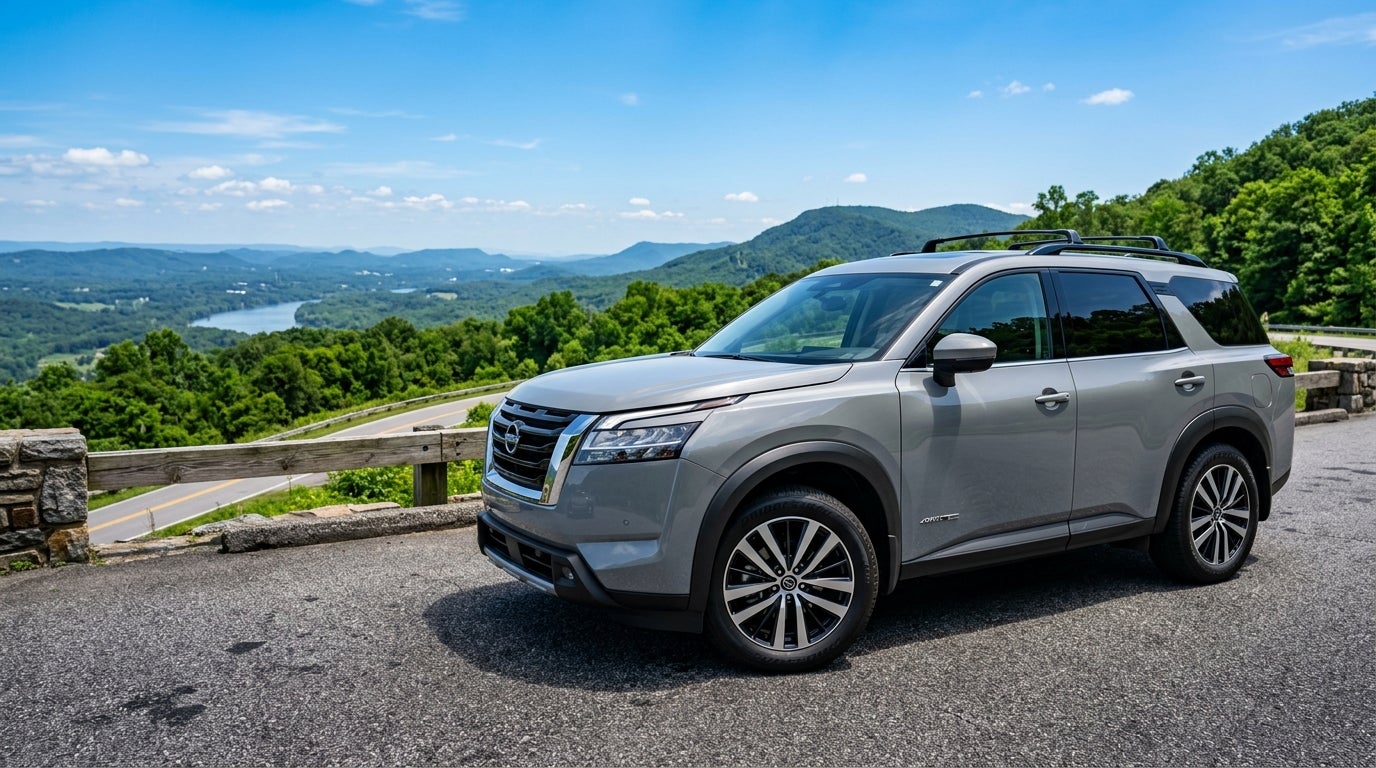
The 2026 Nissan Pathfinder uses three primary factory tire sizes across its lineup: standard P255/60HR18 all-season tires on S, SV, and SL trims; rugged P265/60R18 all-terrain tires on the Rock Creek trim; and lower-profile P255/50R20 all-season tires on the Platinum trim. Choosing or replacing tires for a midsize three-row crossover requires maintaining the exact load index and speed rating specified by the factory. Navigating steep elevation changes along the Appalachian Ridge-and-Valley terrain in Chattanooga demands precise rubber fitment to ensure proper chassis stability, braking distance, and electronic safety system calibration. The Pathfinder carries high crash-test evaluations from safety authorities, and preserving that safety profile relies directly on maintaining correct original equipment tire dimensions. Whether driving standard 18-inch wheels or upgraded 20-inch alloy rims, using factory-approved specifications helps keep speedometer readings accurate and preserves transmission shift logic on the 3.5-liter V6 engine. Drivers seeking local guidance on factory fitment can reach our service advisors at (423) 756-1500 or visit our Market Street service center for complete tire support. Table of Contents What Factory Tire Sizes Come Standard Across Nissan Pathfinder Trims? Which Factory Tire Brands Come Installed on a New Nissan Pathfinder? How Often Should You Rotate and Replace Tires on a Nissan Pathfinder? How Do Michelin and Continental Tires Compare for a Nissan Pathfinder? Frequently Asked Questions About Nissan Pathfinder Tire Care Where to Schedule Nissan Pathfinder Tire Service in Chattanooga What Factory Tire Sizes Come Standard Across Nissan Pathfinder Trims? Factory tire fitments on the Pathfinder vary by trim level to match each model's intended driving purpose and suspension tuning. Base and mid-tier models prioritize ride compliance and dampening over broken pavement, whereas performance-oriented and luxury trims adjust rim diameter and sidewall height accordingly. Pathfinder S, SV, and SL: Standard fitment features P255/60HR18 all-season tires mounted on 18-inch alloy wheels. The tall sidewall on these 60-series tires delivers extra cushioning against potholes and pavement joints. Pathfinder Rock Creek: Equipped with P265/60R18 all-terrain tires mounted on 18-inch beadlock-style alloy wheels. This wider tread face and reinforced sidewall pattern provide enhanced off-road grip for gravel trails and dirt access roads. Pathfinder Platinum: Features P255/50R20 all-season tires on 20-inch machined alloy wheels. The shorter 50-series sidewall increases lateral stiffness, providing sharper steering response during high-speed cornering and highway cruising. Every trim level includes an underbody-mounted compact spare tire with a crankdown mechanism to ensure emergency mobility without compromising interior cargo space. When ordering direct-fit replacements or replacement wheels, drivers can consult our OEM parts department to select factory-authorized tire specifications matched to their specific vehicle trim. Which Factory Tire Brands Come Installed on a New Nissan Pathfinder? Nissan partners with tier-one tire manufacturers to equip the Pathfinder with original equipment rubber designed for quiet operation and long tread life. Depending on production date, trim level, and wheel size, new Pathfinder models feature factory fitments from major brands including Hankook, Michelin, and Bridgestone. Higher trims rolling on 20-inch wheels, such as the Platinum, frequently come equipped with Hankook Dynapro HP2 tires in size 255/50R20 105H M+S. This premium highway all-season tire utilizes a high-grip silica compound and rigid center rib to minimize tread noise while delivering predictable dry and wet handling. Other factory configurations include Michelin Primacy LTX or Bridgestone Alenza Sport A/S compounds engineered specifically to low-rolling-resistance standards. For the off-road-oriented Rock Creek trim, Nissan fits all-terrain tires featuring deeper void ratios and shoulder blocks. These specialized compounds balance moderate trail traction with low highway hum, keeping the interior cabin hushed at cruising speeds. Replacing original equipment tires with equivalent tier-one compounds maintains factory tuned chassis dynamics and prevents premature wear on all-wheel-drive transfer cases. How Often Should You Rotate and Replace Tires on a Nissan Pathfinder? Nissan Pathfinder tires should be rotated every 5,000 to 7,500 miles to promote even treadwear across all four positions. Regular rotation balances the distinct wear patterns created by front-wheel drive weight bias and steering forces, significantly extending overall tire lifespan. Rotation Schedule: Align tire rotations with routine 5,000-mile oil change appointments to keep wear symmetrical. Replacement Lifespan: Average factory and replacement tire lifespans range from 45,000 to 65,000 miles, depending on rubber hardness, road surfaces, and alignment consistency. Recommended Pressure: Maintain a cold tire pressure of 35 PSI across all four tires, as noted on the driver door jamb placard. Owners carrying outdoor gear or driving near Lookout Mountain often notice accelerated outer-shoulder tread wear on front tires due to frequent elevation changes and curving roads. Inspecting tread depth regularly with a tire gauge ensures tread depth remains well above the legal minimum of 2/32 inches. When drivers bring their vehicle in for routine care, they frequently ask whether rotating tires every 5,000 miles is necessary if their commute consists primarily of straight highway driving. Performing consistent rotations prevents front tires from developing heel-toe tread wear, preserving a quiet cabin ride and maximizing tire mileage. How Do Michelin and Continental Tires Compare for a Nissan Pathfinder? Selecting replacement tires for a Pathfinder often comes down to choosing between premium tire manufacturers like Michelin and Continental. Both brands produce exceptional replacement tires for three-row crossovers, but each brand emphasizes distinct performance characteristics. Michelin tires—such as the Defender LTX M/S or Primacy series—are engineered around maximum tread longevity and acoustic comfort. Michelin utilizes proprietary rubber compounds that resist uneven wear, frequently delivering usable tread life beyond 60,000 miles. The firm shoulder construction provides excellent tracking stability on long interstate drives, making them a preferred option for drivers who prioritize quiet cabin comfort and maximum mileage between replacements. Continental tires—such as the CrossContact LX25—excel in wet-weather braking efficiency and hydroplaning resistance. Continental designs tire tread patterns with wide circumferential grooves and dense siping that clear water effectively during heavy rain. While Continental options may wear slightly faster than comparable Michelin options under aggressive driving, they offer a suppler ride feel over sharp pavement impacts along with competitive replacement pricing. Frequently Asked Questions About Nissan Pathfinder Tire Care Q: What is the recommended cold tire pressure for a 2026 Nissan Pathfinder? The factory recommended cold tire pressure for a 2026 Nissan Pathfinder is 35 PSI for all four road tires. Checking tire inflation pressure in the morning before driving ensures accurate readings, which helps maintain fuel economy and prevents uneven shoulder wear. Q: Does changing tire size affect the Pathfinder's ProPILOT Assist safety features? Installing non-standard tire dimensions alters rolling circumference, which can throw off speedometer readings and miscalibrate distance-calculating algorithms used by ProPILOT Assist and automatic emergency braking systems. Always stick to factory-approved sizes like P255/60HR18 or P255/50R20 to keep advanced driver-assist safety tech operating properly. Q: How do 18-inch and 20-inch Pathfinder tires differ in overall ride quality? Standard 18-inch tires feature taller sidewalls that absorb road bumps and potholes more effectively, yielding a softer ride. Optional 20-inch tires feature shorter sidewalls that enhance steering feedback and cornering stability, though they transmit slightly more pavement texture into the cabin. Q: Do all-wheel-drive Pathfinder models require replacing all four tires at once? Replacing all four tires simultaneously on all-wheel-drive models prevents tread depth variances that strain the transfer case and differential electronics. If replacing only two tires is unavoidable, the new tires must match the existing tires in brand, model, size, and load index, and be installed on the rear axle. Q: Where can I book a professional tire inspection or rotation appointment? You can book routine tire maintenance, computerized wheel alignments, or full replacement services by scheduling tire service online with certified technicians who utilize factory-calibrated tire equipment. Where to Schedule Nissan Pathfinder Tire Service in Chattanooga Maintaining proper tire health requires expert inspection, precise balancing, and factory-aligned installation procedures. Our certified service team specializes in complete tire care for every generation of the Nissan Pathfinder in Chattanooga, ensuring your crossover handles predictably on every road condition. From routine tread depth checks and pressure resets to mounting new tier-one replacement tires, our facility utilizes state-of-the-art balancing machines and alignment racks tailored specifically to Nissan chassis specs. Keeping your tires properly rotated and inflated preserves all-wheel-drive system health, maximizes fuel efficiency on your 3.5-liter V6, and protects your family on every trip. To consult with our factory-trained advisors or arrange your next service visit, contact our team directly at (423) 756-1500 or visit our Chattanooga service center today. © 2026 Mtn View Nissan of Chattanooga. All rights reserved.
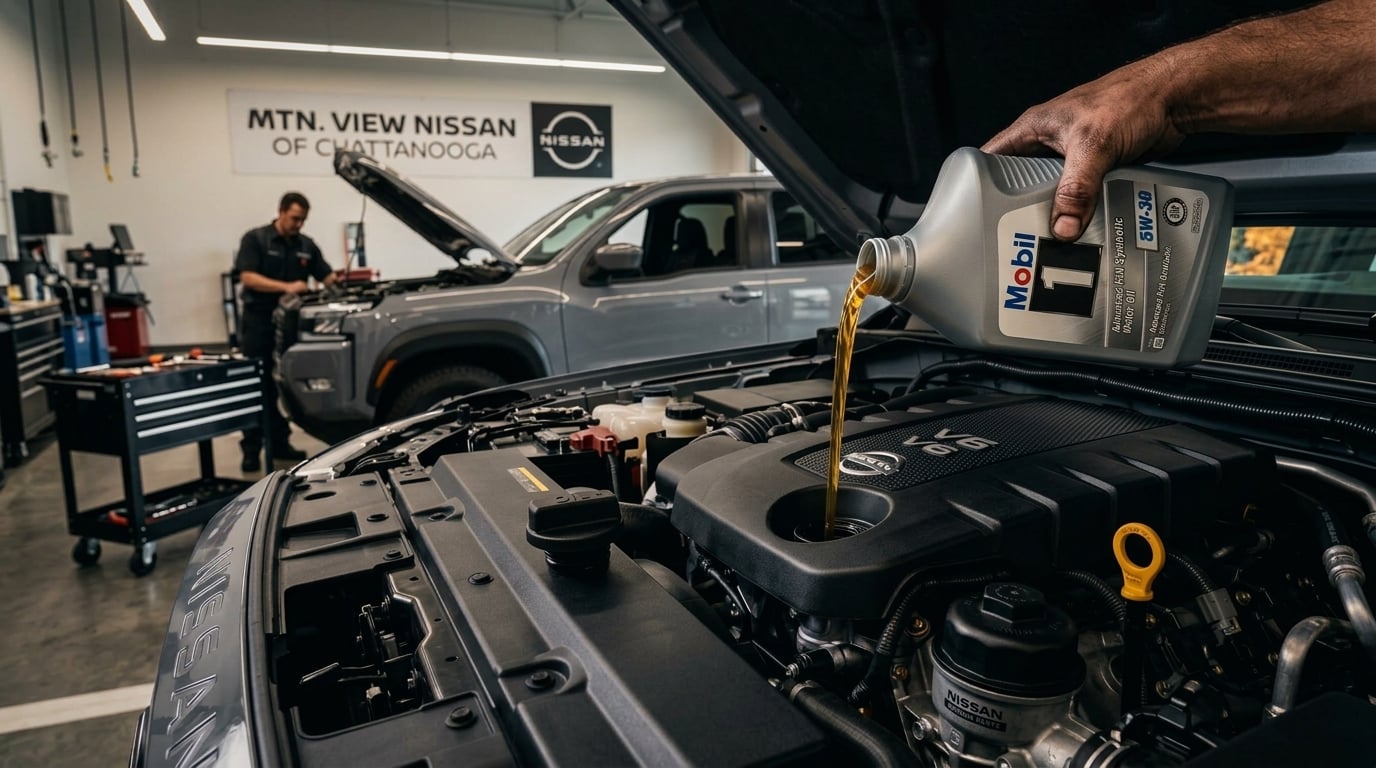
What Are the Oil Service Requirements for a Nissan Frontier

What Are the Oil Service Requirements for a Nissan Frontier?

Under normal driving conditions, the Nissan Frontier equipped with the 3.8L V6 engine requires an oil and filter change every 7,500 miles or 12 months, using 0W-20 full synthetic motor oil meeting ILSAC GF-6A standards with a total engine oil capacity of 5.4 quarts. Drivers operating under severe conditions—including frequent trailering, off-roading, or short-distance urban commuting—must follow a shortened interval of 3,750 miles or 6 months to maintain internal engine cleanliness and protect thermal efficiency. Proper lubrication is the foundation of long-term mechanical reliability for midsize pickup trucks. The direct-injected 3.8L V6 engine operates under high internal pressures and tight mechanical clearances. Fresh synthetic oil flows through internal galleys to lubricate the overhead camshafts, timing chain assemblies, and cylinder walls while absorbing heat generated during heavy acceleration and towing. Following factory-specified service schedules ensures that protective additives remain active, preventing harmful varnish buildup and keeping engine components operating within target temperature ranges. At Mtn View Nissan of Chattanooga, our factory-trained service technicians deliver certified maintenance tailored specifically to your truck's engineering requirements. When you bring your vehicle to our Chattanooga service center, our team uses original equipment manufacturer parts and precision bulk filling systems calibrated for exact fluid volumes. Whether your truck serves as a daily work vehicle or a weekend adventure rig, maintaining correct oil health keeps your engine performing at its peak. You can schedule a service appointment online or give our service department a call at (423) 756-1500 to establish a consistent maintenance routine. Table of Contents What Is the Recommended Oil Change Interval and Capacity for the 3.8L V6? What Counts as Severe Driving Conditions for a Nissan Frontier? What Happens If You Delay an Oil Change on Your Pickup? How Much Does a Dealership Oil Change Cost in Chattanooga? How Do You Reset the Maintenance Light and Inspect Standard Engine Features? Frequently Asked Questions About Nissan Frontier Maintenance Schedule Certified Nissan Service at Mtn View Nissan What Is the Recommended Oil Change Interval and Capacity for the 3.8L V6? The recommended oil change interval for a 2026 Nissan Frontier in Chattanooga, powered by the 3.8L V6 engine, is 7,500 miles or 12 months under standard operating conditions, with a precise oil refill capacity of 5.4 quarts when replacing the oil filter. Nissan engineers explicitly specify 0W-20 full synthetic motor oil that satisfies ILSAC GF-6A quality standards for this engine platform. Full synthetic formulations provide superior resistance to viscosity breakdown compared to conventional or synthetic-blend oils. At cold startup, 0W-20 oil flows rapidly to upper engine components, minimizing initial metal-on-metal friction before the engine reaches full operating temperature. Under heavy load, the synthetic base stock resists thermal oxidation, maintaining a stable protective film across bearing surfaces even during sustained highway driving or hill climbs. Pairing high-grade synthetic oil with a genuine OEM oil filter is equally critical. Factory Nissan oil filters feature synthetic filter media engineered to capture microscopic contaminants without restricting oil pressure. They also incorporate an internal anti-drainback valve that holds oil within the filter housing when the engine is turned off. This prevents dry startups by ensuring instant oil pressure delivery the moment the ignition is engaged. Owners who prefer to perform their own fluid checks or source factory-approved components can consult our genuine OEM Nissan parts department to obtain exact-fit filters, crush washers, and approved lubricants. What Counts as Severe Driving Conditions for a Nissan Frontier? Severe driving conditions for a Nissan Frontier include regular trailer towing, hauling heavy bed payloads, driving on dusty or unpaved mountain roads, making frequent short trips under 5 miles in cool weather, and idling extensively in traffic. When a truck routinely encounters these operation demands, Nissan guidelines recommend reducing the oil service interval to 3,750 miles or 6 months. Operating a midsize pickup in diverse geographical environments directly impacts oil longevity. The Appalachian Ridge-and-Valley region surrounding Chattanooga presents distinct driving challenges, from steep grade climbs up Lookout Mountain to frequent stop-and-go traffic along river valley corridors. Towing a boat or camper places sustained high thermal loads on the engine, accelerating the rate at which engine oil oxidizes and breaks down. Similarly, driving along unpaved gravel routes or dirt access trails introduces fine airborne dust that can contaminate crankcase air if intake systems and filters are stressed. Short-trip driving is another common severe condition that many truck owners overlook. When trips last less than 5 miles, the engine oil rarely reaches its full operating temperature of roughly 200 degrees Fahrenheit. As a result, moisture from combustion bypass and unburned fuel vapor accumulate inside the oil pan rather than evaporating off. Over time, this moisture reacts with oil additives to form acidic sludge, which degrades corrosion protection. When truck owners stop in to ask about maintenance schedules after heavy weekend trailering, our technicians walk them through these environmental factors to help choose the safest maintenance interval for their driving habits. What Happens If You Delay an Oil Change on Your Pickup? Delaying an oil change on a Nissan Frontier causes motor oil to break down chemically, resulting in sludge formation, elevated engine friction, accelerated component wear, decreased fuel economy, and potential voiding of your 5-year/60,000-mile powertrain warranty. As motor oil ages beyond its intended service life, heat and mechanical shear forces break down the long-chain polymer molecules that give synthetic oil its protective viscosity characteristics. Detergent and dispersant additives become depleted, allowing soot, carbon deposits, and metallic wear particles to clump together. This sticky sludge coats internal surfaces, clogging delicate oil passages and restricting oil flow to critical high-friction areas such as variable valve timing actuators and hydraulic lifters. Over time, oil starvation leads to permanent mechanical damage. Excessive friction accelerates wear on piston rings, cylinder walls, and timing chain guides, which can cause abnormal engine noise and oil consumption. Furthermore, the direct-injected 3.8L V6 engine relies on clean, high-pressure oil flow to maintain peak efficiency. In independent owner studies such as J.D. Power vehicle dependability surveys, the Nissan Frontier consistently earns reliability scores in the low- to mid-80s out of 100, reflecting its robust design. However, preserving that long-term durability requires adhering to routine fluid service so internal components remain properly lubricated and protected against heat wear. How Much Does a Dealership Oil Change Cost in Chattanooga? A factory-authorized dealership oil change for a 2026 Nissan Frontier in Chattanooga generally costs between $80 and $120 for full synthetic oil and a genuine OEM filter. Investing in certified dealer service offers substantial value beyond the raw cost of oil and a filter. Every Frontier oil change at our service center includes a complete multi-point inspection performed by factory-trained technicians who specialize exclusively in Nissan vehicles. Technicians inspect brake pad thickness, suspension bushings, drive belts, air filtration systems, battery health, and tire tread depth. Identifying minor wear items early prevents costly roadside breakdowns and keeps your truck operating safely across varied weather conditions. Choosing authorized dealership service also ensures accurate fluid management and precise record-keeping. Our technicians utilize bulk dispensing equipment to deliver the exact 5.4 quarts of 0W-20 full synthetic motor oil required for the direct-injected V6, preventing overfilling or underfilling issues common at quick-lube outlets. Furthermore, all service records are automatically logged into Nissan's centralized vehicle history database, providing clear documentation of completed maintenance that protects your factory warranty coverage and enhances resale value when trading in your truck down the road. How Do You Reset the Maintenance Light and Inspect Standard Engine Features? To reset the oil change maintenance light on a 2026 Frontier in Chattanooga, navigate through the Advanced Drive-Assist Display in the instrument cluster using the left-hand steering wheel controls, select the Settings menu, scroll down to Maintenance, choose Service, and press and hold the OK button until the mileage counter resets to zero. Resetting the maintenance reminder should always follow a physical oil and filter change to ensure the digital tracking matches actual fluid condition. While performing routine service, taking time to visually inspect under-hood components helps catch potential issues early. Key areas to check include: Dipstick Oil Level: Pull the engine oil dipstick, wipe it clean, reinsert it fully, and pull it out again to verify the oil level rests between the upper and lower operating marks. Engine Air Filter: Unclip the air cleaner housing to inspect the intake filter element for accumulated dust, leaves, or road debris that could restrict airflow to the V6 engine. Fluid Levels: Check coolant, brake fluid, and windshield washer reservoirs to verify levels meet marked cold fill lines. Serpentine Drive Belt: Inspect the accessory drive belt for surface cracking, fraying, or uneven edge wear. The standard direct-injected 3.8L V6 engine produces 310 hp and 281 lb-ft of torque, backed by a responsive 9-speed automatic transmission. Maintaining proper fluid levels and clean air filters preserves this powertrain's responsive throttle delivery, allowing trucks configured for towing to confidently handle loads up to 6,680 lbs (or up to 7,150 pounds when properly equipped) without overheating or losing efficiency. Frequently Asked Questions About Nissan Frontier Maintenance Q: What type of motor oil does a 3.8L V6 Nissan Frontier require? The Nissan Frontier with a 3.8L V6 engine requires 0W-20 full synthetic motor oil certified to meet ILSAC GF-6A specifications. Synthetic oil provides rapid cold-weather flow to critical engine components during startup while resisting high-temperature viscosity breakdown during heavy hauling or hot summer driving. Q: How many quarts of oil are needed for a Frontier oil change? A standard engine oil and filter change on a 3.8L V6 Nissan Frontier requires approximately 5.4 quarts of motor oil. Technicians always verify final fluid height using the engine dipstick after running the engine briefly to fill the new oil filter housing. Q: Can I drive 10,000 miles between oil changes in a Nissan Frontier? Driving 10,000 miles between oil changes is not recommended for a Nissan Frontier. Nissan factory specifications mandate a maximum interval of 7,500 miles or 12 months under normal driving conditions, and 3,750 miles or 6 months under severe driving conditions, to prevent oil sludge and maintain warranty protection. Q: What is included in a factory Nissan Express Service oil change? A factory Nissan Express Service oil change includes draining old oil, installing 5.4 quarts of 0W-20 full synthetic motor oil, replacing the engine oil filter with an original equipment filter, resetting the maintenance indicator light, and completing a comprehensive multi-point vehicle inspection. Q: Does frequent towing lower the oil change interval on a Nissan Frontier? Yes, frequent trailer towing or hauling heavy cargo falls under severe driving conditions. The extra strain elevates engine temperatures and accelerates lubricant degradation, requiring oil and filter replacements every 3,750 miles or 6 months to protect internal engine components. Schedule Certified Nissan Service at Mtn View Nissan Keeping up with routine oil changes is the single most effective action you can take to preserve the power, performance, and long-term value of your Nissan Frontier. Our team at Mtn View Nissan of Chattanooga is dedicated to delivering efficient, factory-certified vehicle care using genuine Nissan parts and approved synthetic lubricants. Visit our state-of-the-art service facility located at 2100 Market St, Chattanooga, TN 37408, or call our service department directly at (423) 756-1500 to set up your next maintenance appointment. © 2026 Mtn View Nissan of Chattanooga. All rights reserved.