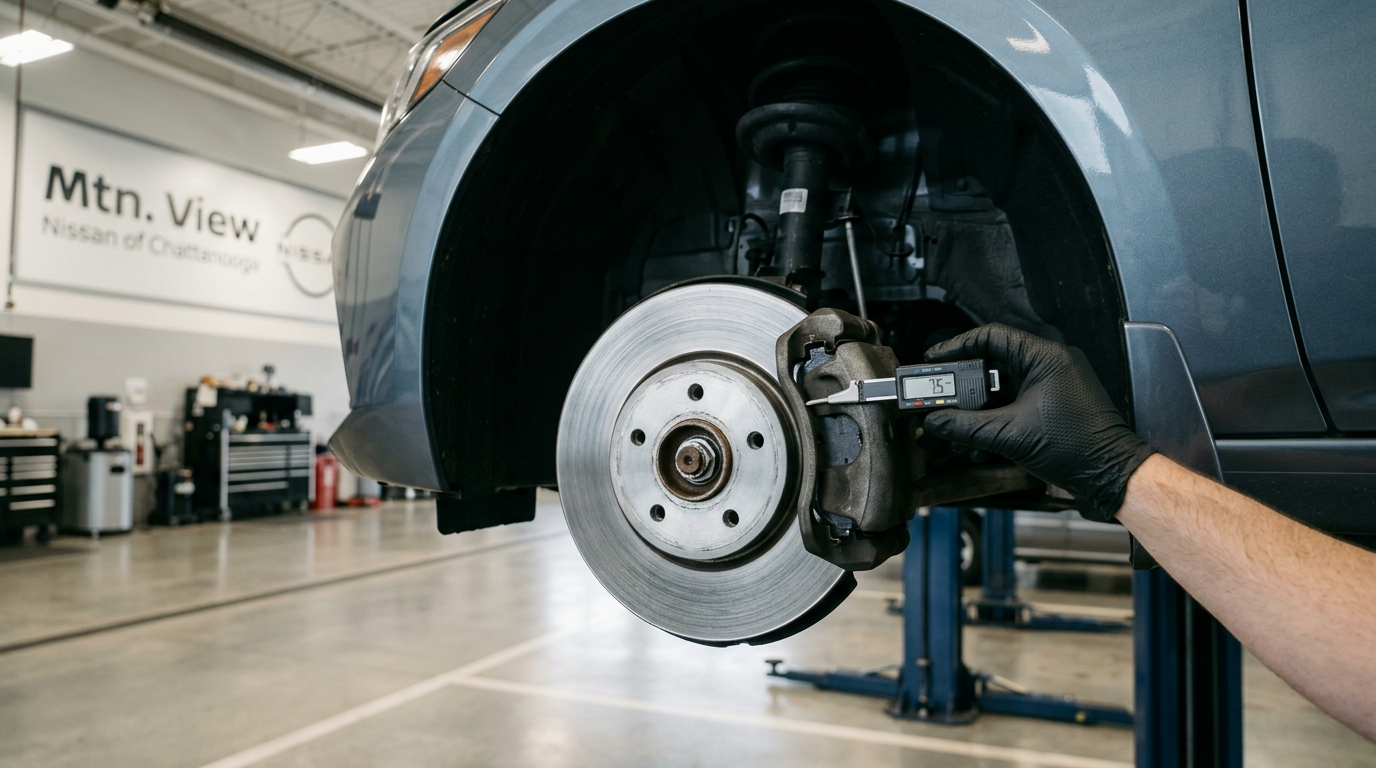

A Nissan Sentra requires a professional brake inspection every 5,000 to 7,500 miles—typically aligned with routine oil changes—while brake pad replacement is generally necessary every 30,000 to 70,000 miles. Exact replacement intervals vary based on individual driving habits, traffic density, and friction material type. Daily stop-and-go commuting along the Tennessee River valley around Chattanooga accelerates pad and rotor wear compared to open highway driving. Keeping up with scheduled brake inspections prevents minor friction wear from developing into costly rotor damage or compromised hydraulic performance. During a standard service visit, factory-trained technicians measure remaining friction pad thickness in millimeters, examine the physical condition of front and rear rotors, inspect hydraulic lines for moisture contamination, and check brake fluid levels. Driving conditions significantly dictate friction component longevity. Aggressive braking, carrying heavy cargo loads, or frequent hill descents near Lookout Mountain increase operating temperatures within the braking assembly. High heat accelerates pad degradation and can lead to thermal glazing on the rotor surface. Conversely, steady highway driving puts minimal strain on the system, pushing replacement needs closer to the upper end of the mileage spectrum. When routine maintenance indicates that friction components are nearing minimum safety thresholds, choosing timely service ensures maximum stopping power and preserves related suspension and drivetrain components. Vehicle owners can easily visit our service center on Market Street or give our team a quick call at (423) 756-1500 to consult with an advisor regarding recommended maintenance schedules. Table of Contents What Type of Brake System Does the Nissan Sentra Use? What Are the Key Signs That Your Nissan Sentra Needs Brake Service? How Much Does Nissan Sentra Brake Pad Replacement Cost? Does Installing Aftermarket Brake Parts Void Your Nissan Warranty? Common Questions About Nissan Sentra Brake Maintenance Certified Nissan Sentra Brake Maintenance in Chattanooga What Type of Brake System Does the Nissan Sentra Use? Modern Nissan Sentra models utilize a four-wheel disc brake system equipped with an Anti-lock Braking System, Electronic Brake-force Distribution, Brake Assist, and an Electric Parking Brake with Hill Hold Control. Recent model years feature 11-inch vented front disc rotors and 10.2-inch solid rear disc rotors, replacing older rear drum configurations to deliver enhanced heat dissipation and balanced stopping performance across all four wheels. The hydraulic architecture works in unison with electronic driver-assist safety suites. The standard 2.0-liter four-cylinder engine, delivering 149 horsepower and 146 lb-ft of torque through an Xtronic continuously variable transmission, relies on precise hydraulic pressure management to maintain directional vehicle stability under heavy deceleration. Key mechanical and electronic components within this network include: Vented Front Rotors: Internal cooling vanes pump air through the rotor as it spins, rapidly shedding heat generated during hard braking stops. Solid Rear Rotors: Provide consistent clamping pressure to equalize braking bias, working alongside electronic proportioning controls. Anti-lock Braking System (ABS): Monitors individual wheel speeds via magnetic sensors, modulating hydraulic pressure rapidly during sudden stops to prevent wheel lockup and preserve steering control. Electronic Brake-force Distribution (EBD): Dynamically shifts braking pressure between front and rear axles based on current vehicle weight distribution and passenger load. Brake Assist: Detects panic-braking behavior by measuring the speed of brake pedal depression, automatically applying maximum hydraulic boost before the driver depresses the pedal fully. This integrated electronic and mechanical hardware ensures consistent pedal response and shortened stopping distances under varied road and weather conditions. What Are the Key Signs That Your Nissan Sentra Needs Brake Service? Squealing or grinding noises, a soft or spongy brake pedal, steering wheel vibration during deceleration, and extended stopping distances are the primary indicators that a Nissan Sentra requires immediate brake inspection. Modern friction pads incorporate mechanical wear sensors that emit a continuous high-pitched metallic chirp when pad material wears down to approximately 2 millimeters. Recognizing these diagnostic warning signs early prevents severe damage to surrounding wheel-end assemblies: High-Pitched Squealing: Triggered by a built-in metal indicator clip contacting the spinning rotor, signaling that pad material is depleted and replacement is overdue. Harsh Metallic Grinding: Occurs when friction material is entirely worn away, causing the steel backing plate to clamp directly against the rotor surface, causing deep scoring and requiring complete rotor replacement. Pedal Pulsation or Steering Vibration: Indicates lateral runout or uneven thickness variation across the rotor surface, often caused by severe thermal warping. Spongy or Low Brake Pedal: Points to air trapped within hydraulic lines, severe brake fluid degradation, or internal master cylinder bypass leaks. Vehicle Pulling to One Side: Suggests a sticking caliper slide pin, uneven pad wear, or a restricted hydraulic brake hose. Addressing these symptoms promptly restores factory stopping performance and safeguards against unexpected system failure. Vehicle owners noticing any of these warning signs can easily schedule a multi-point brake inspection online to have our certified technicians evaluate the friction system. How Much Does Nissan Sentra Brake Pad Replacement Cost? Replacing brake pads on a 2027 Nissan Sentra in Chattanooga generally costs between $150 and $300 per axle for parts and labor, depending on whether ceramic or semi-metallic friction materials are selected and whether the rotors require machining or total replacement. When rotor replacement is needed alongside pad installation, full axle service typically ranges higher due to additional component costs and precise fitment labor. Total repair costs are influenced by mechanical condition, parts specification, and labor requirements across several key areas: Friction Material Selection: Ceramic brake pads generally carry a slightly higher parts cost than semi-metallic alternatives, but they produce significantly less dark brake dust and offer quieter operation for daily city driving. Rotor Resurfacing vs. Replacement: If rotors retain sufficient disc thickness above minimum discard specifications, resurfacing on a precision lathe restores a smooth finish at a lower cost than installing new rotor core castings. Caliper and Hardware Servicing: Replacing worn guide pin boots, stainless steel abutment clips, and applying high-temperature synthetic lubricant ensures smooth caliper sliding and prevents premature pad taper. Diagnostic Precision: Professional technicians conduct digital caliper measurements across multiple rotor points to determine whether resurfacing remains a safe, viable option. Commuters navigating dense local traffic often ask our service advisors whether factory ceramic pads or alternative formulations offer longer service life under frequent stop-and-go driving. Genuine Nissan parts match original factory specifications for friction coefficient, thermal resilience, and noise damping. Drivers interested in maintaining factory build standards can order genuine Nissan brake pads directly through our specialized parts center. Does Installing Aftermarket Brake Parts Void Your Nissan Warranty? Installing aftermarket brake components does not void a Nissan factory warranty under federal protection established by the Magnuson-Moss Warranty Act. Vehicle manufacturers cannot deny warranty coverage simply because non-OEM or third-party replacement parts were installed, provided those parts function correctly and meet basic operational standards. However, warranty protection becomes nuanced if an aftermarket component fails or causes direct damage to adjacent factory systems. Key warranty considerations include: Causal Connection Requirement: A dealership or manufacturer must legally prove that an aftermarket part directly caused damage to a covered assembly before denying a specific warranty claim. System-Specific Limitations: If an improper aftermarket brake pad or caliper causes damage to an ABS wheel speed sensor or wheel hub assembly, repairs for those affected components will not be covered under factory warranty. Maintenance Record Keeping: Retaining detailed invoices and service records showing regular maintenance intervals prevents disputes regarding neglect if a warranty claim arises. Factory Engineering Standards: Genuine Nissan parts are backed by a dedicated 12-month/12,000-mile limited warranty and are engineered specifically to match factory ABS and brake assist calibration. Choosing original equipment components ensures guaranteed fitment, preserves factory safety calibrations, and maintains full comprehensive warranty integrity without operational compromise. Common Questions About Nissan Sentra Brake Maintenance Q: How long do factory Nissan Sentra brake rotors typically last? Factory brake rotors on a Nissan Sentra usually last between 50,000 and 70,000 miles under normal driving conditions. Rotor lifespan depends heavily on driving style, ambient moisture exposure, and whether brake pads are replaced before wearing down to their steel backing plates. Routine inspection during every oil change helps identify minor scoring or uneven thickness variation before severe vibration develops. Q: What causes the brake pedal in a Nissan Sentra to feel soft or spongy? A spongy brake pedal feel is primarily caused by air moisture contamination in the hydraulic lines, deteriorated brake fluid, or internal seal leakage within the master cylinder. Moisture lowers the boiling point of hydraulic fluid, generating compressible vapor bubbles under high thermal stress. Nissan recommends flushing and replacing brake fluid every 20,000 to 30,000 miles to maintain firm pedal resistance. Q: Are visual brake inspections included with routine oil changes? Multi-point inspections performed during scheduled oil changes at authorized service centers typically include a comprehensive visual check of brake pads, rotors, caliper slide movement, and fluid reservoirs. Technicians measure outer pad thickness and inspect rotor surfaces for rust ridge accumulation or deep scoring, providing a clear report on remaining component life. Q: What is the benefit of ceramic brake pads over semi-metallic options for a sedan? Ceramic brake pads feature a dense compound of ceramic fibers and non-ferrous filler materials that generate light-colored, non-abrasive dust that does not easily bond to alloy wheels. They operate with significantly less noise across normal operating temperatures and extend rotor surface life during daily city commuting compared to harder, metallic formulations. Q: How does Automatic Emergency Braking affect routine brake component wear? The Intelligent Forward Collision Warning with Automatic Emergency Braking system uses front radar sensors to detect potential hazards, applying swift hydraulic force to prevent collisions. While routine driver-initiated stopping accounts for over 99% of total pad wear, emergency automated stops apply rapid, full clamping force, making routine hardware inspections essential to ensure maximum system readiness. Certified Nissan Sentra Brake Maintenance in Chattanooga Maintaining your vehicle's stopping system with factory-certified components ensures long-term driving safety, original pedal feel, and proper integration with advanced driver-assist safety technologies. Our factory-trained technical staff utilizes specialized diagnostic tools, precision rotor measuring equipment, and genuine Nissan friction materials designed explicitly for your sedan. Whether your vehicle requires a basic fluid check, friction pad replacement, or complete rotor machining, professional care preserves operational integrity and long-term resale value. Drivers can stop by our dealership located at 2100 Market St, Chattanooga, TN 37408, or use our digital portal to get directions to our facility. For immediate assistance or to speak directly with a factory-trained service specialist, feel free to contact our team at (423) 756-1500 to schedule your next maintenance appointment. © 2026 Mtn View Nissan of Chattanooga. All rights reserved.